Agentic AI for Ecommerce
Top 15 Tools to Consider

10 min read

In a highly competitive ecommerce environment, giving customers quick responses and a great customer experience is a long-term competitive advantage. Agentic AI ecommerce tools companies are emerging as a new class of solutions driving change in the industry. As a result, more and more brands are using AI agents to help customers with customer service and sales assistance. Agentic commerce is reshaping the ecommerce landscape by enabling AI-driven, autonomous systems to enhance customer experience, make personalized recommendations, and manage complex processes.
Buyers will want to assess different functionalities ranging from being able to handle simple FAQ use cases all the way to more complex customer service use cases such as warranty claims. On top of this, ecommerce brands will want a solution that can be customized to their brand, both in terms of tone of voice and design, but also in terms of specific business processes and policies. Key benefits provided by these tools include advanced business intelligence, workflow automation, and operational efficiency, which streamline operations and support data-driven strategies.
As customer service is one of the areas where AI deployments are strongest, and the use cases are most obvious, there are a lot of providers to consider, and new ones popping up all the time trying to prove themselves. The shift to agentic commerce is also disrupting traditional SEO and direct web traffic that digital retailers have relied on. We’ve capped it at 15, but it’s by no means exhaustive.
The introduction of AI agents marks a significant shift in the ecommerce landscape at technical, organizational, and experiential levels. These agents are expected to drive a new era of personalization, business intelligence, and operational efficiency in ecommerce.
This blog will explore some of the options in the space that CX leaders in ecommerce should look into. There are three main categories: ecommerce-specific, helpdesk AIs, and generalist tools. These solutions are designed to integrate with existing systems to maximize impact and revenue growth.
Ecommerce specific AI agents
When buying technology, it’s often good to go with a provider who has a strong niche – they know the thing they do well.
The obvious advantage that ecommerce-specific AI tools have is their speciality. By design, these tools are built to optimize ecommerce operations and drive ecommerce sales through advanced automation. They should be able to handle the types of questions that shoppers have with their eyes closed. Additionally, ecommerce business intelligence features in these tools provide actionable insights, enabling brands to make informed decisions that improve performance and growth.
These AI tools excel at handling shopper questions, but also leverage real time data, product data, and efficiently manage customer inquiries to improve customer satisfaction by delivering seamless, personalized experiences.
DigitalGenius
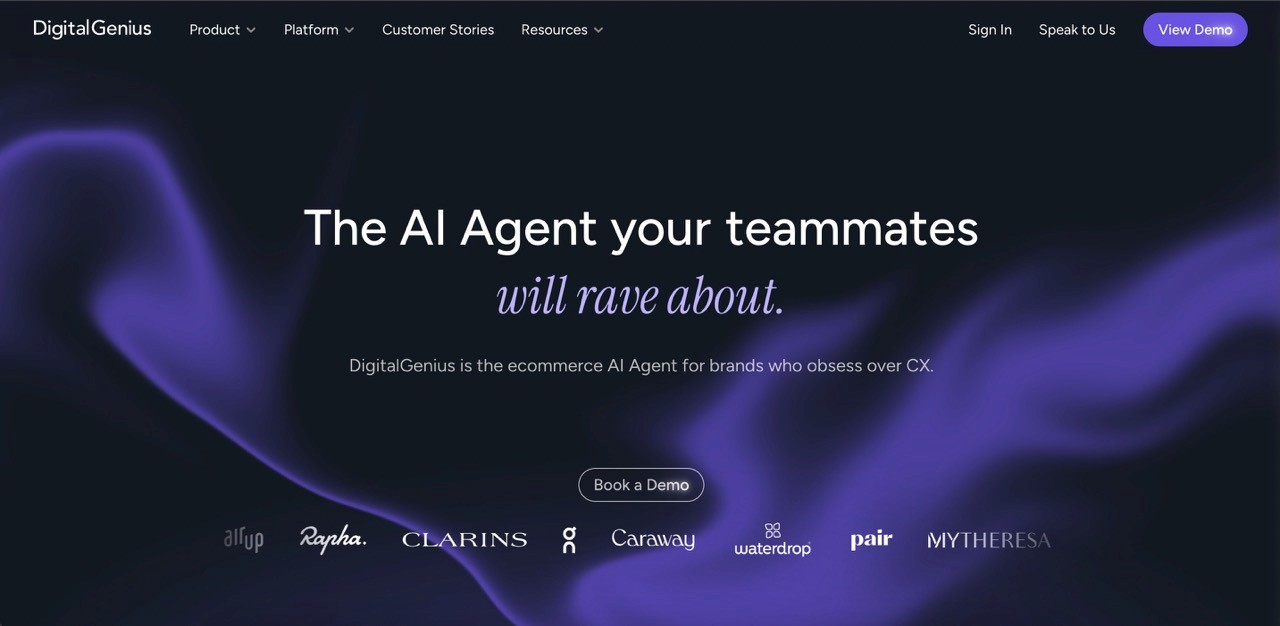
DigitalGenius has specialised in AI Agents for ecommerce since 2019, way before anyone had heard of ChatGPT. That level of experience means that DigitalGenius is able to automate and resolve most queries that a customer service agent would face every day.
DigitalGenius AI agents integrate with internal systems and warehouse systems to automate inventory management, monitor supplier performance, and enable demand forecasting for better operational efficiency.
This experience has been distilled into Genius Flows, DigitalGenius’s out-of-the-box workflows for common ecommerce use cases such as WISMO or Returns. Brands can connect their systems in as little as half an hour, and be automatically resolving customer service queries in a day or two. AI agents can forecast demand, optimize stock levels, and automate reordering to prevent both stockouts and overstock.
DigitalGenius takes a hybrid approach to AI, combining specialist LLM agents with structured workflows. This approach means that the agents can scale in all directions: horizontally to manage more use cases, vertically to deal with complex conversations and workflows, and in parallel to be replicated across different brands and geographies.
Through deep integrations with ecommerce tools, AI can not only answer customer questions, but take actions that an agent would take. This can include issuing refunds, approving warranty claims, sending out replacement orders, escalating lost orders with carriers, and much more. Any new integrations are built free of charge. AI agents can also streamline data reporting for ecommerce businesses by pulling data from multiple sources into coherent reports.
DigitalGenius offers a range of products: Care AI to handle post-purchase customer service; Purchase AI that offers product recommendations and advice; Proactive AI to alert customers’ proactively; Voice AI to handle phone-based conversations; and Insights AI that surfaces data and trends from the voice of the customer.
Brands who use DigitalGenius can see significant automation in the first year, which continues through active management from the customer success team.
DigitalGenius has a range of integrations with all major ecommerce platforms, including Salesforce, Shopify, BigCommerce, WooCommerce, Scayle, Magento, Commerce Tools, Centra and more.
Siena
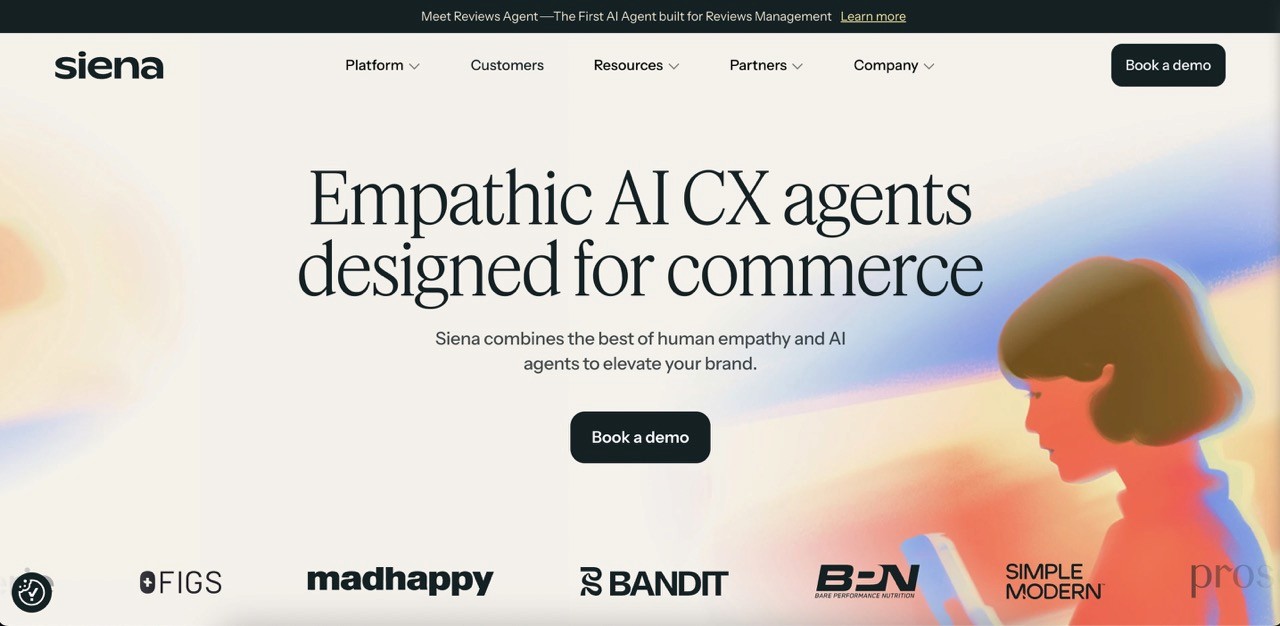
Siena is an AI customer service platform for ecommerce brands. Siena emphasizes its empathic nature, consistent tone, and sentiment awareness so responses match a brand’s style.
Siena uses an agentic brand intelligence layer to collect and analyze customer interactions. This supports product discovery and personalized shopping experiences by understanding customer needs and preferences, enabling deep personalization and actionable business insights.
Siena integrates with Shopify brands, and helpdesks like Dixa, Gladly, Gorgias, Kustomer and Zendesk.
Kodif
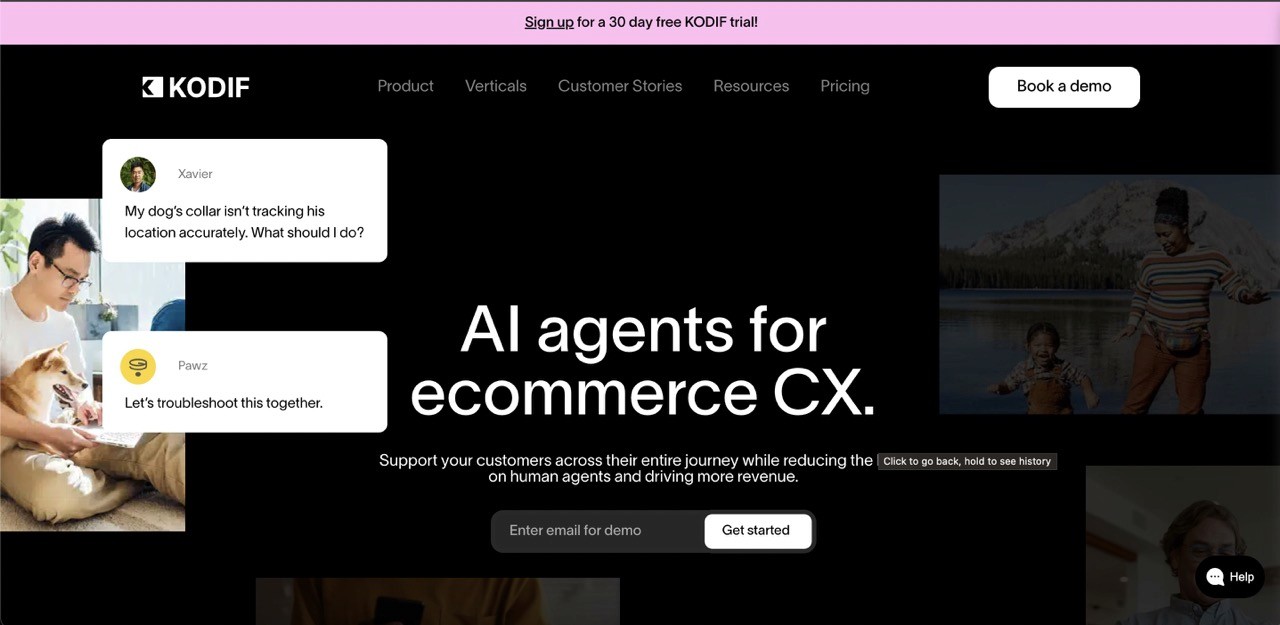
Kodif is a Customer Support AI platform that makes processes more efficient, allowing for faster resolutions with a human touch. Kodif emphasises resolution as a KPI that brands can achieve, as opposed to deflection.
Kodif also showcases its data analytics and insights that allows CX teams to find areas for improvement. These analytics help improve supplier performance and operational efficiency by identifying bottlenecks and optimizing workflows.
While Kodif’s public customers are so far in the ecommerce and subscription space, their ROI calculator suggests they also serve other industries like SaaS, Fintech, Insurance and Travel.
Yuma.ai
Yuma.ai is an ecommerce AI platform that aims to transform ecommerce through AI enhanced experiences. Created in 2022, Yuma was originally built as a support app on the Gorgias store. Since then, it’s added Sales AI, Social AI, and Chat AI to its platform.
Yuma emphasizes scalability & consistency, and a quick set up process. Yuma has a mix of AI Agents and Auto-Pilots that follow SOPs for certain processes. Yuma uses Fact Snippets which can be inserted verbatim into responses.
Yuma’s AI agents can handle customer inquiries and automate repetitive tasks, freeing up human teams to focus on higher-value work. They can also generate product descriptions quickly, provide immediate chat assistance, offer personalized discounts, and highlight low-stock items to create urgency and boost sales.
Yuma integrates with a number of key helpdesks such as Kustomer, Gorgias & Zendesk. Currently, the only ecommerce platform listed as integration on their site is Shopify.
In summary, agentic AI ecommerce tools companies empower brands to automate complex workflows, improve decision-making, and scale hyper-personalized marketing. This leads to increased conversion rates, higher customer satisfaction, and more efficient ecommerce operations.

Helpdesk AIs
Many helpdesks have embedded AI functionality in order to help customers. Much of this is about helping to summarise conversations and bring agents up to speed, but most now have customer-facing agents. Automated customer support powered by AI agents leverages customer data and customer preferences to deliver personalized experiences, improving customer satisfaction and operational efficiency.
As most helpdesks are generalist, and sit across industries, the level of expertise they can have into any one industry is limited. As a result of being outside the core product, it can sometimes be a secondary consideration. However, multi agent systems can work together to handle complex workflows, optimizing processes such as ticket routing and escalation. But most can help with FAQs and some basic-level of automation, and for buyers looking to consolidate technologies it is a valid option. AI agents also reduce reliance on human agents by automating routine customer inquiries.
But, if you are considering moving helpdesks, then it might be worth looking for an external provider to avoid getting locked into contracts.
Gorgias AI
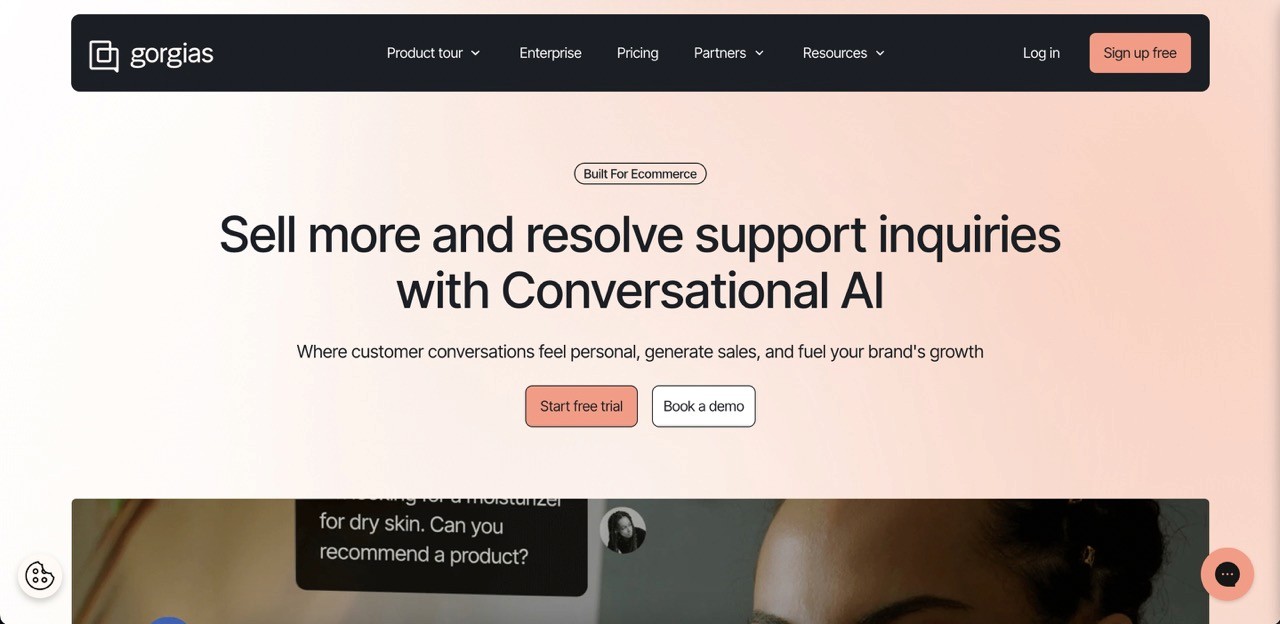
Gorgias is an exception to the rule above because it is an ecommerce-specific helpdesk. In fact it claims to be the only AI Agent built for ecommerce – which some of the companies above would dispute.
As such it has integrations with many ecommerce platforms (it also claims to be the #1 CX Platform for Shopify) as well as other ecommerce technologies. As a helpdesk it is used by over 16,000 Shopify merchants, so it is fair to say that it serves smaller retailers very well.
Its AI agent is divided into a pre-purchase Shopping Assistant and a post-purchase Support Agent. The Gorgias AI agent uses workflow automation to streamline ticket management and improve operational efficiency.
Dixa AI (Mim)
Dixa is a CX platform for consumer brands in ecommerce, travel, transport, and subscriptions. It allows agents to handle more conversations with less effort.
Mim, Dixa’s AI agent, can respond automatically to customers about repetitive queries, as well as offering conversation summaries for agents. Mim also analyzes customer behavior to provide personalized support.
Dixa offers a unified agent workspace so conversational context is retained across channels. It includes no code workflows, and intelligent routing of tickets. Mim handles conversations across email and chat for Dixa’s customers.

Zendesk AI Agents
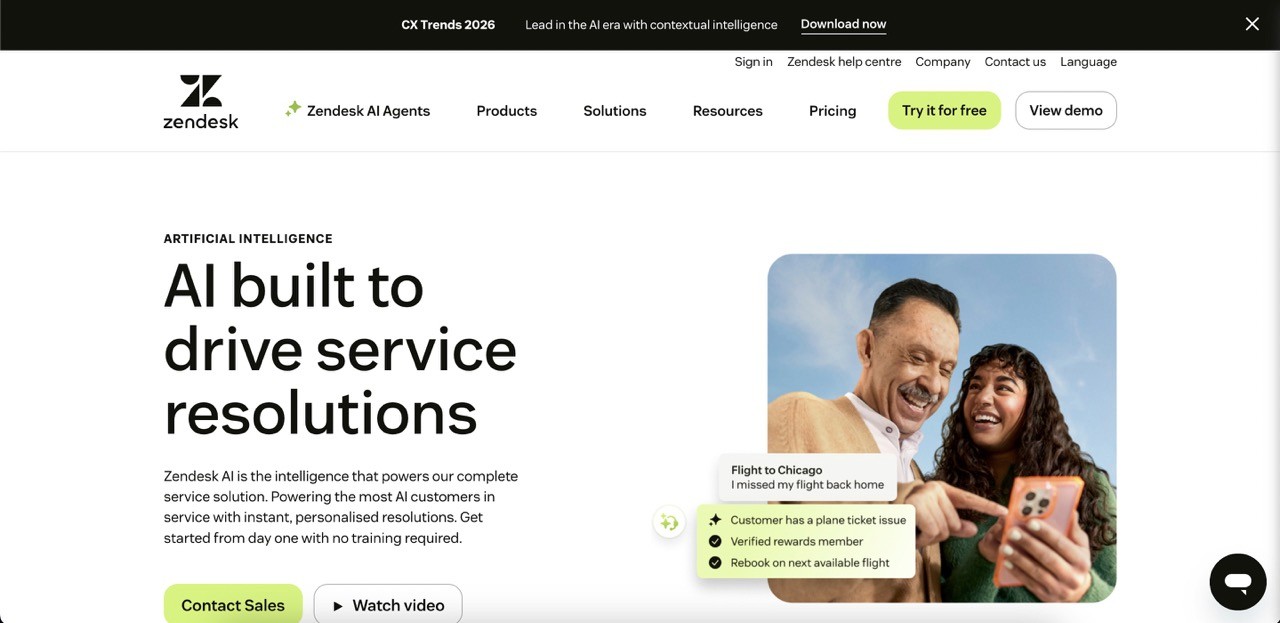
Zendesk is used by over 100,000 businesses globally across pretty much any industry you could think of. It claims to be a complete customer service solution.
Zendesk AI Agents is a product borne out of Zendesk’s own development, as well as an acquisition of Ultimate.ai. On their website, Zendesk say that their agents can be launched quickly and do not require technical expertise. Zendesk AI agents can handle up to 80% of routine inquiries, reducing support costs by 30%.
The product is pre-trained across a variety of sectors, including financial services, insurance, IT, HR, travel, hospitality, tourism, retail, software, entertainment and gaming, and education. Furthermore, customers have the flexibility to easily incorporate customized intents.
Kustomer AI
Kustomer is a CRM that serves customers in sectors including Technology, consumer services, insurance and travel, as well as ecommerce. Kustomer combines data, agents, AI & humans to be one CX platform.
Their AI Agent platform is designed to resolve customer service queries, not simply deflect them. Customers can deploy multiple specialized agents across multiple channels.
Kustomer believe in the power of anticipation, and the future of using AI and intelligence to help customers before they reach out. Their platform leverages customer data to provide personalized recommendations and improve customer satisfaction.

Gladly AI
Gladly is another helpdesk that serves multiple different industries including healthcare, media & entertainment, travel & hospitality, online marketplaces, telecommunications and consumer goods, as well as Retail & Ecommerce.
Gladly AI Agents is an evolution of its Gladly Sidekick product. Customers can train their agents using plain language, similar to prompts, to allow the agents to take the defined steps.
This allows a non-technical person to build AI Agents and make amendments themselves. Gladly AI agents provide seamless omnichannel engagement and continuity in conversations.

Intercom Fin
Intercom claims to offer a “complete customer service solution” that brings together chat, automation, and messaging to help businesses build stronger customer relationships at scale.
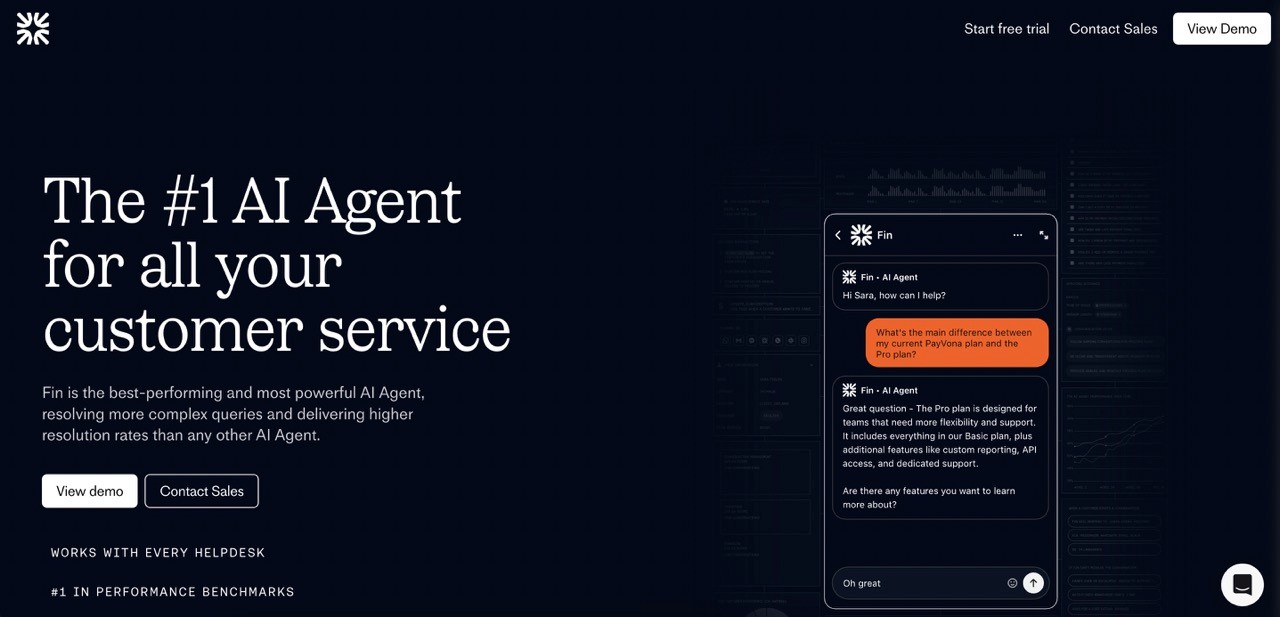
Fin is an AI agent designed for customer-service teams across a wide range of industries including Education, Fintech & Financial Services, Health & Wellness and Retail & Ecommerce. It resolves customer queries by drawing on a company’s own support knowledge and policies. Fin adapts in real-time based on customer behavior and preferences to deliver a more personalized experience.
The company states that Fin uses a proprietary architecture called the Fin AI Engine™, which refines customer queries, retrieves relevant content, and validates answers to maintain accuracy and reduce hallucinations.
Generalist tools
The final group are the Generalist AI Agent platforms. There are hundreds of platforms for building AI Agents across different use cases, but we are going to stick with customer service and customer experience for this article. Generative AI tools and AI assistants are foundational technologies for building agentic AI tools that automate tasks, enhance customer experience, and power agentic ai ecommerce tools companies.
For the most part, generalist tools are designed to be used by lots of different industries, so they prioritise breadth of use over depth. This means that they should be able to easily answer query types that are common across industries, such as FAQs and policies that are stated on the website or knowledge bases. Commerce agents, agentic AI tools, and agentic commerce AI agents are advanced solutions for online stores, enabling automation, intelligent decision-making, and proactive customer engagement.
As a result, they may lack the expertise to easily handle complex queries in these industries, meaning that customers will have to navigate the workflows and complex integrations themselves. Support will naturally vary from company to company, but companies may need to devote dedicated resources to these platforms. As a result, they may be better suited to enterprise organisations.
Many also use prompt-only workflows, which can struggle to handle complex processes as the agent can take unexpected actions, and give inconsistent and incorrect answers, as we explain here. However, multi step tasks and multiple agents can collaborate to handle complex processes, improving reliability and efficiency in agentic architectures.
Decagon
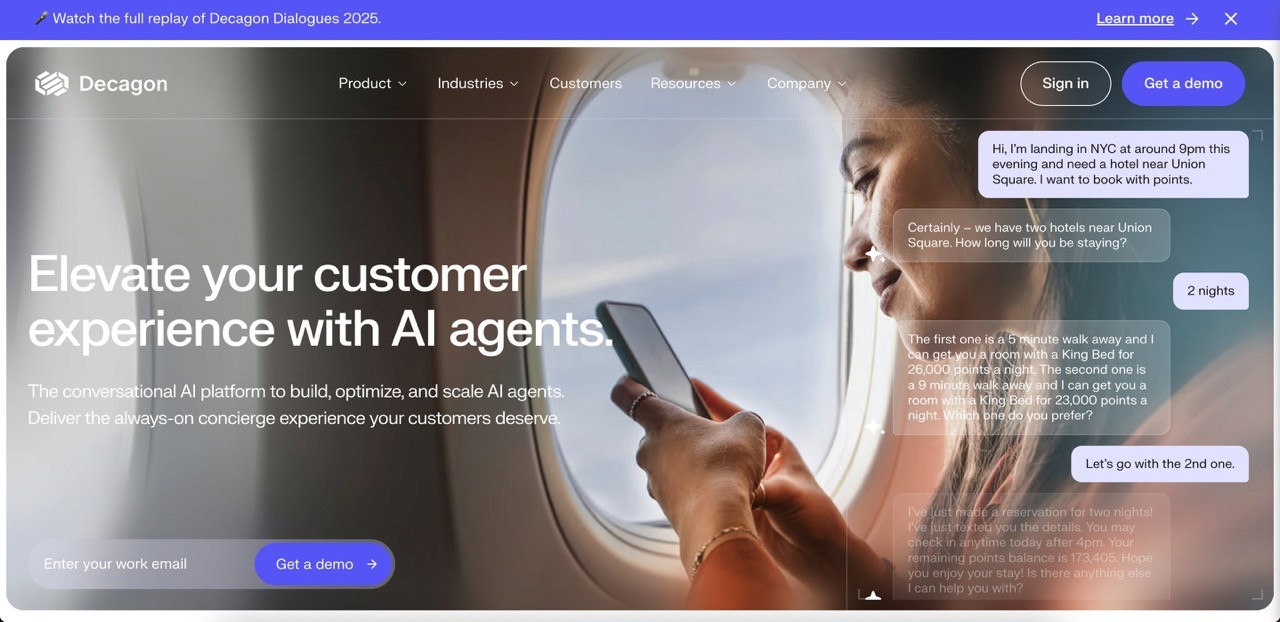
Decagon is a generalist conversational-AI platform designed for customer experience teams across multiple industries.
The company states that its system brings together a unified knowledge graph, transparent decision-logic and enterprise-grade guardrails to support brand-consistent responses at scale. It terms these Agent Operating Procedures (AOPs) – building agents using prompts only.
Decagon’s website says that it enables brands to build, optimise and scale AI agents that handle chat, email, voice and SMS across any channel. Their platform supports integrating AI agents with messaging apps and other channels to provide a smoother customer experience.
Sierra
Sierra was founded by OpenAI’s chair Bret Taylor. According to its website, Sierra helps businesses “build better, more human customer experiences with AI.”
The company indicates a focus on B2B enterprise customers across sectors like media, tech, travel, financial services, and retail. Sierra uses an Agent OS to build, manage, and optimize its agents.
Its Agent SDK allows users to build and configure agents without writing a line of code – using natural language, i.e. prompts. Sierra’s Agent OS leverages natural language processing and brand voice to deliver personalized support.

Salesforce Agentforce
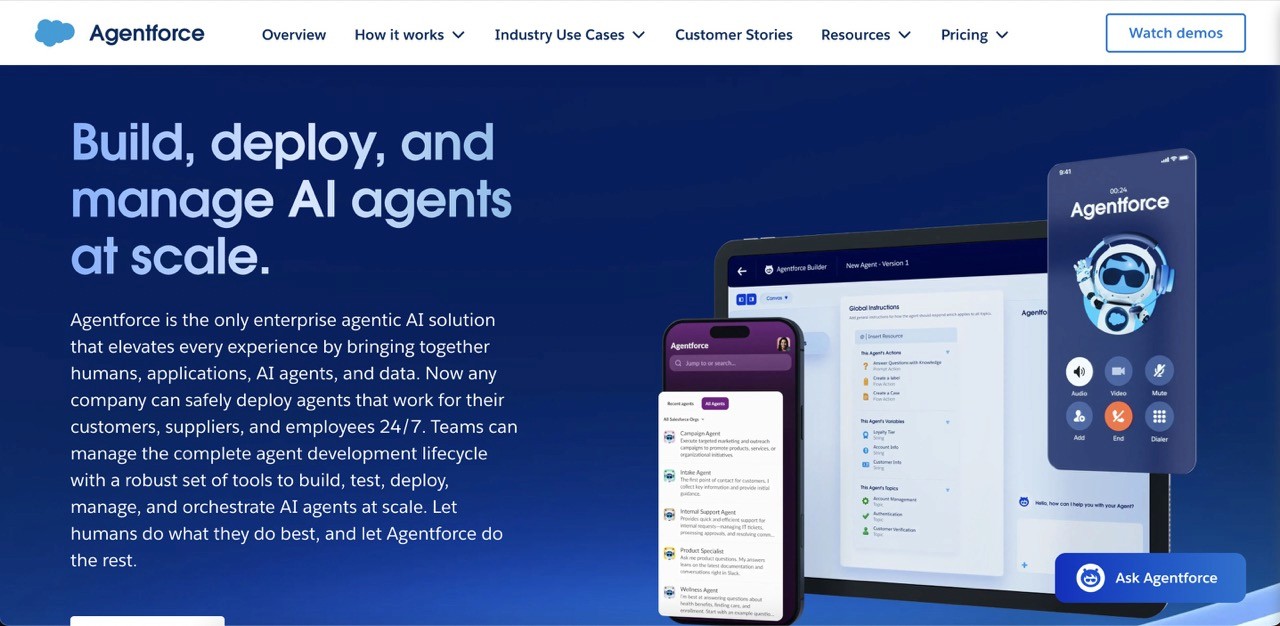
Agentforce is the evolution of Salesforce’s Einstein Copilot. It allows businesses to create AI agents capable of reasoning, accessing data and taking action. The idea is that the agents can pull data from Salesforce sources and execute actions without human intervention.
Using a Prompt Builder, users can draft prompts to explain what they want an agent to do - allowing them to retrieve structured and unstructured data.
Salesforce suggests working with experts from Salesforce Professional Services or Certified Partners in order to confidently deploy agents fast. Their agents can handle dynamic pricing, custom pricing, and analyze purchasing history to optimize sales.
Yellow.ai
Yellow ai is an Agentic AI platform that works with financial services, healthcare andutilities, as well as retail brands. Yellow ai uses multiple LLMs with the aim of increasing speed and accuracy.
Yellow ai has Agent Builder 2.0 which allows users to build and deploy AI Agents using prompts. By defining goals users can let the system work out how it handles the necessary steps and actions.
For retail brands, Yellow ai integrates with ecommerce platforms like Shopify, Woocommerce, and Magento. Their platform enables ecommerce agents to automate product discovery and provide personalized recommendations.

. Zowie
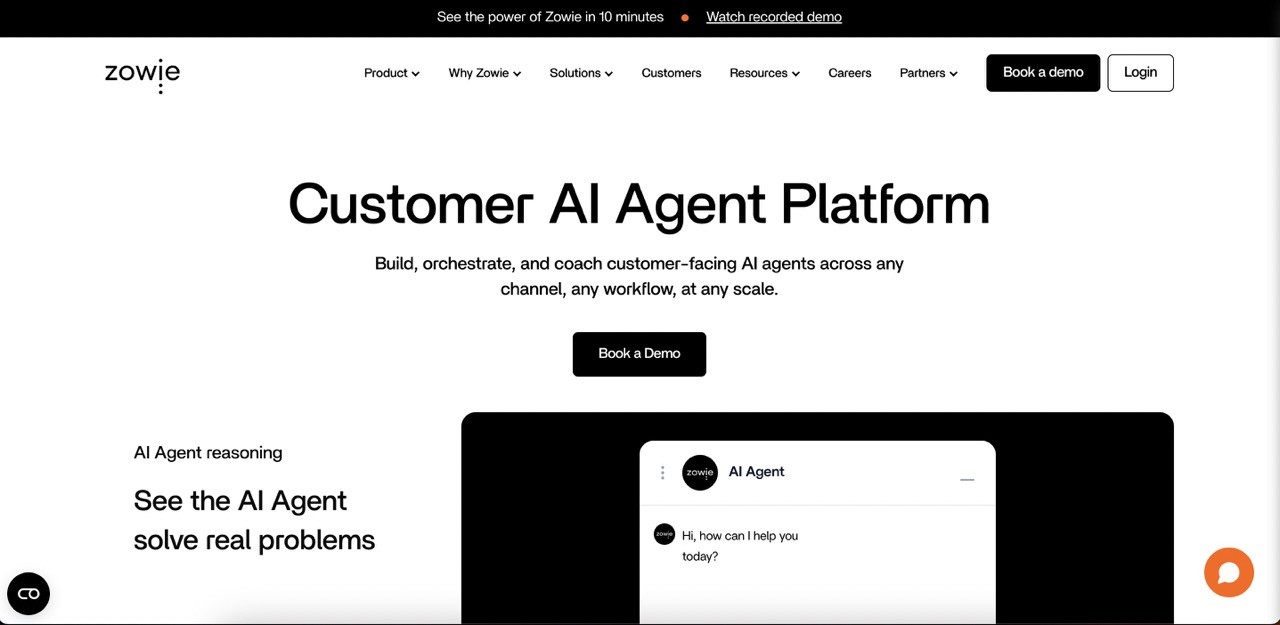
Zowie is an AI customer service platform for multiple industries. It was built on the principle that conversations should be the default way that customers interact with brands.
It uses a proprietary intelligence layer (“X2”, Decision Engine, Reasoning Engine) to capture and analyze customer interactions, execute workflows, and integrate data from support, commerce and fulfilment systems.
Zowie has a customer-facing AI Agent to automate customer conversations as well as a backoffice AI Inbox to help boost agent productivity. Zowie’s AI agent can generate product descriptions quickly, monitor prices, and provide immediate chat assistance.
If you are an ecommerce brand looking to automatically answer and resolve customer service queries, there are clearly a number of options available to you. This is not an exhaustive list by any means.
We would recommend you look at providers that have a deep understanding of ecommerce and the use cases required, as well as ones that integrate well with your helpdesk and other platforms.
In summary, agentic AI tools and commerce agents are transforming online stores by automating complex workflows, improving customer satisfaction, and delivering a smoother customer experience.
In that case, DigitalGenius should be on your shortlist to consider.